
© 2025 Puja Goyal
—
It begins with a question, not a lesson.
“Why did Malala hide her books?” a teacher asks, a classroom of restless children who suddenly sit a little straighter.
“Who is Malala?”
Not because it’s part of the curriculum. Not because it’s in the textbook. But because a story has begun—and stories are magnetic.
This is where the new National Education Policy (NEP) quietly opens its windows. A shift from rote learning to rooted understanding. From marks to meaning. From memory to mettle.
And storytelling, humble and human, becomes the bridge.
At its heart, NEP is not just policy—it’s philosophy. It invites us to teach not merely what to think, but how to think, feel, question, and dream. Storytelling fits this vision not as an accessory, but as an instrument.
Let’s unpack this, one tale at a time.
Take foundational literacy and numeracy—the bedrock of NEP’s early goals. Numbers, on their own, can be lonely creatures. But tell a tale of a little boy who traded three mangoes for a secret map, and suddenly math has narrative muscle. Words become ladders. Stories become logic in disguise.
Or consider critical thinking and problem-solving. NEP encourages interdisciplinary curiosity—blurring the lines between science, art, and ethics. What better way than through the story of a young village girl who notices her well is drying and invents a rainwater harvester using old tin cans and folklore she heard from her grandmother?
She’s not just a character. She’s the curriculum.
Even vocational education—often sidelined—finds dignity through narrative. Why teach “entrepreneurship” through jargon, when you can tell the story of a cobbler’s son who created biodegradable chappals using banana fibre?
When stories are told with care, they don’t just teach. They translate policy into lived possibility.
But most of all, storytelling restores something vital: joy.
It invites multilingual exploration—another NEP cornerstone. Children can share a story in Marathi, retell it in Hindi, act it out in English. Each version retains the soul, while language flows like a river around it. Story becomes the connector, not the container.
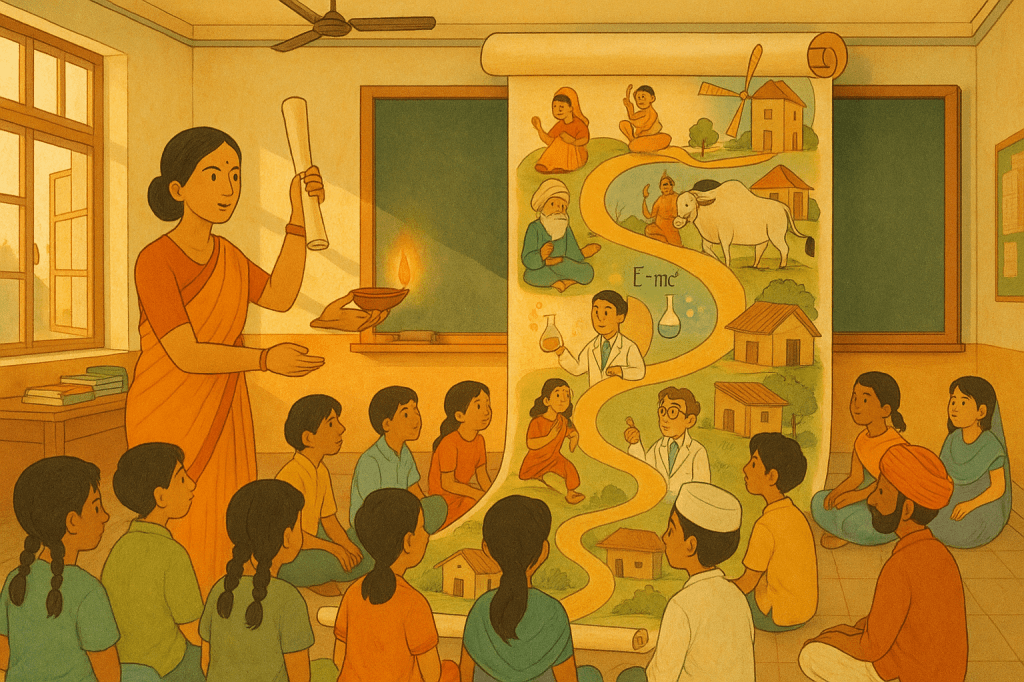
For teachers, this isn’t about “adding” one more tool. It’s about re-seeing the classroom as a stage, the syllabus as a scroll, and each learner as both listener and storyteller.
Even assessments can shift. Instead of “List 5 causes of iodine deficiency,” try, “You are an 11-year-old aspiring to be a nutritionist. Write a letter to your ailing cousin about how to heal his goiter.” You’ll assess the same knowledge—but engage empathy, perspective, and creativity.
NEP is asking us to be brave. To leave behind chalk-and-talk. To walk with our students through forests of imagination and across bridges of relevance.
So let’s dust off the old tales. Let’s write new ones. Let’s tell the story of a policy not with PDFs and PowerPoints but with people and passion.
Because when a child remembers a story, they don’t forget the lesson. And when a country teaches through stories, it doesn’t forget its soul.
“I hope you are enjoying these posts so far. Drop in a text to learn more and your feedback so I can write more. Thank you for reading“
 DreamScope Theatre
Leave a comment