
© 2025 Puja Goyal
—
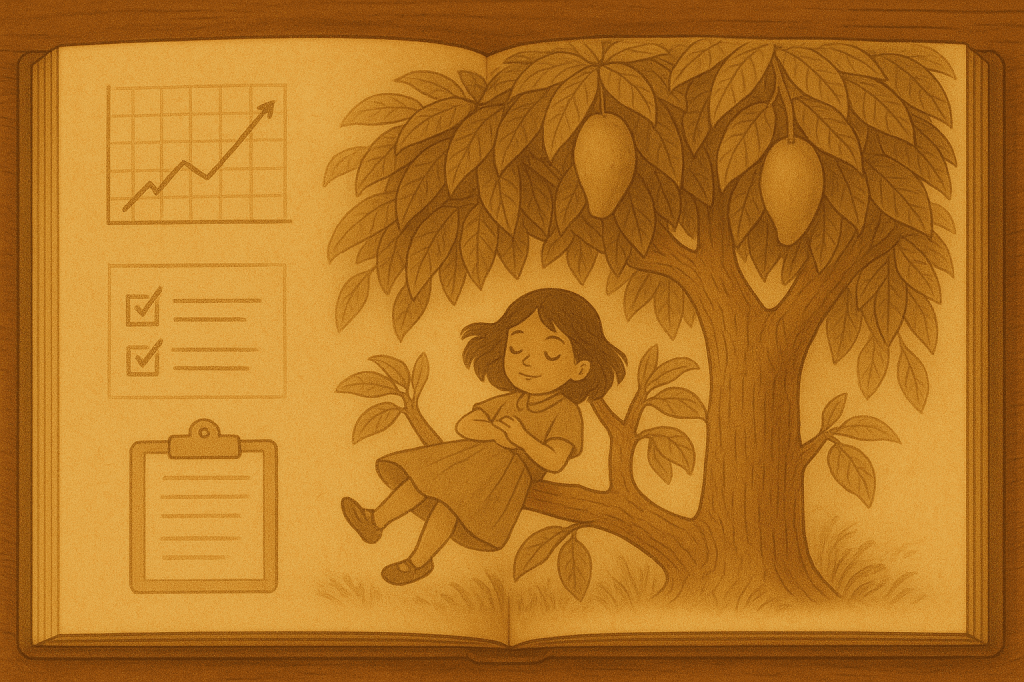
Somewhere in the margins of an old book — the kind with dog-eared pages and ink-smudged corners — there’s a note. Faint pencil, slanted script: “Ask her about the mango tree.”
Nobody remembers who wrote it. But it changed the way the team saw her. The woman in question had never spoken much. She led with spreadsheets, firm nods, and a polite smile. Until one day, at the edge of an exhausted strategy meeting, someone asked about the mango tree.
She told them a story.
About growing up with her grandmother, climbing mango trees barefoot, falling once and being caught — not by a person, but by the lower branches, thick with leaves. “Even when you fall,” she said, “sometimes the world is ready to hold you.”
That meeting turned. Not because of policy. Because of pulse.
We often talk about leadership in terms of vision, efficiency, decision-making. But the best leaders — the ones we remember, trust, follow without resistance — know how to tell a story. Not to manipulate. Not to entertain. But to connect.
Storytelling isn’t a soft skill. It’s a sharp one.
It cuts through noise. It holds tension. It holds us.
A story can move a team when data stalls them. It can soften defensiveness, bridge silos, and create clarity when a slide deck cannot. It allows people to feel before they respond. And people who feel — deeply, vividly — take action that lasts.
When I worked with a new teacher once, she struggled to manage her class. No amount of discipline worked. Until one day, in a moment of surrender, she told the students about her first heartbreak. How she cried through her geography homework, and how she still can’t look at maps without remembering. The room changed. The kids — rowdy, loud, disinterested — became quiet. Tender. They asked her questions. They handed in homework. They began to write their own stories.
Leadership begins when someone risks being human first.
And storytelling? It’s how we give others permission to do the same.
So whether you’re leading a school, a family, a startup, or a single stubborn classroom, try this:
Pause the presentation. Lower your voice. And say: “Let me tell you something real.”
It doesn’t have to be perfect. It has to be true. And if it’s true, it will find them.
Even years later — in a hallway, on a train, in the margin of an old book — they’ll remember you. Not for your policy. But for the mango tree.
Coming Soon: The Storytelling Classroom—a professional development workshop by DreamScope Theatre, designed for educators, facilitators, and communicators seeking to elevate their teaching through the art of storytelling.
Because the future of education begins with how we speak, listen, and connect.
 DreamScope Theatre
Leave a comment