
© 2025 Puja Goyal
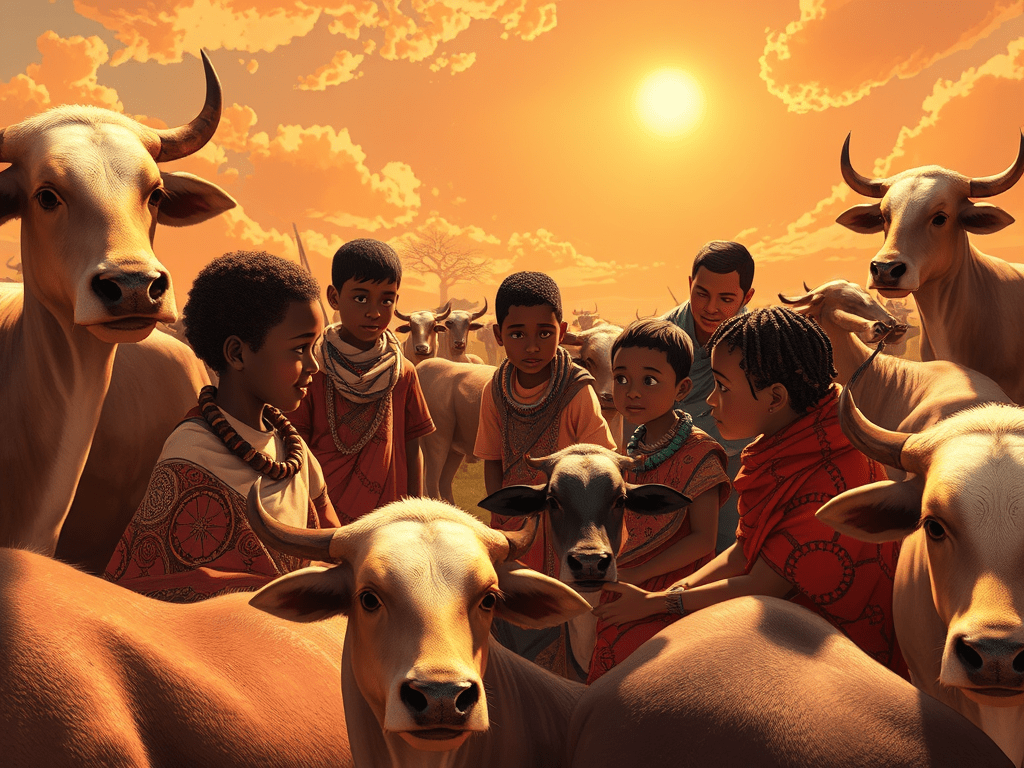
Some stories don’t begin with a whiteboard. They begin under a sun-soaked sky, where numbers are measured not in marks but in livestock.
It was a Wednesday and it was my first geography lesson in school with Ms. Rao. We were looking forward top opening our thick Geography text book and being tutored by her for the first time. We’d heard a lot about her love for teaching children and so we being children, were excited that she would teach us.
She opened the book to the chapter on the Masai tribe. We were neck-deep in fractions, with restless legs and pencil-chewed frustration. And a story from Geography would be an oasis in math storm.
One student had groaned, “But when are we ever going to use this? We are learning fractions and now this… who is going to visit the Masai tribe anyway?”
Instead of answering, she said, “Let me tell you about the Masai.”
The room stilled. looking forward to being transported into another world.
She told us how the Masai, a nomadic tribe in East Africa, have no written language for numbers as we know them. But they know, with startling precision, the age of every cow in their herd, the distance to the nearest watering hole, the ratio of milk to be shared during dry months. They don’t calculate; they intuit. Their math lives in their bodies, in movement, in memory. It’s math as muscle, not subject.
One child blinked. Another sat up straighter.
Then she went on to tell us about their food habits and clothing and we couldn’t believe people could drink the blood of the veins of the cows and it served as water.
That day, something shifted.
Not because I used the perfect formula, or even because the Masai story was exotic — but because it was true. Because it reminded us that math, like all knowledge, begins in the body and becomes language later. It made the lesson feel alive again. That stories around the world can inform and educate about culture, that Geography introduced us to culture and people.
Storytelling, I’ve learned, is not decoration. It is translation.
It’s how you make the abstract tangible, the distant intimate.
Whether you’re teaching math, or a history lesson or managing a meeting, storytelling is the way you bring the room to life — not with gimmicks, but with meaning. And clarity doesn’t always come from explanation. Sometimes it comes from a narrative bridge, from stepping sideways into a world where the same lesson already breathes.
Over the years, I’ve heard many such stories: of the Inuit measuring time by snowfall and of ancient Indian traders using finger calculations long before calculators were born. Every time, the classroom breathes differently. The children don’t just learn — they arrive.
And so, if you are a teacher, a communicator, or a leader — and you find yourself stuck, unheard, or misunderstood — pause the instruction. Tell a story. Take them somewhere else to bring them back to now.
Your voice does not need to be loud. But it must be real.
Because the moment you tell a story, you’re not just giving information. You’re giving memory.
And memory, dear friend, is what makes knowledge stay.
Coming Soon: The Storytelling Classroom—a professional development workshop by DreamScope Theatre, designed for educators, facilitators, and communicators seeking to elevate their teaching through the art of storytelling.
Because the future of education begins with how we speak, listen, and connect.
 DreamScope Theatre
Leave a comment