
© 2025 Puja Goyal
Let’s take a situation we all face – the Math problem. While some children take to Math easily, there are others who consider it a nightmare. Mathematics has a bad reputation and considerign that Algebra and Calculus joins in later on doesn’t make it better.
As a case study for match teachers I want to describe a situation …
There’s a girl in the third row, squinting at the board as if the math problem , her brains shut, and she isn’t able to not only solve it but is scared what the teacher will think. She’s also previously failed many times in math and now with all the pressure, she’s lost hope. But her situation is she can’t avoid it and has to sit through the class. Her pencil hovers, hesitating. Her brow furrows.
Then as a teacher leans in (thinking how do I make it easy for her, instead of scolding her) — not with an answer, but with a story.
“Imagine,” he says, “you’re baking laddoos. You’ve got six friends coming over and 24 laddoos. How many does each one get?”
Suddenly, fractions aren’t floating numbers. They’re round, sweet, and slightly sticky. He has just mentioned her favourite sweet.
Clarity — true clarity — isn’t about dumbing things down. It’s about lighting a lamp where fog once was. It’s not about “explaining better.” It’s about seeing through the student’s eyes, walking into their frame of reference, and inviting them, gently, into yours.
The best teachers aren’t those who know the most. They’re the ones who can make others know.
Let’s be honest: storytelling is often dismissed as fluff — how can we teach math with stories? But those who know, know. It’s not fluff. It’s material. It’s how you make ideas digestible, how you make neurons fire with context.
When you tell a story — even a tiny one, even a metaphor or an anecdote — you’re not just transferring information. You’re transferring attention. And attention is the currency of learning.
There’s a quiet elegance to articulation.
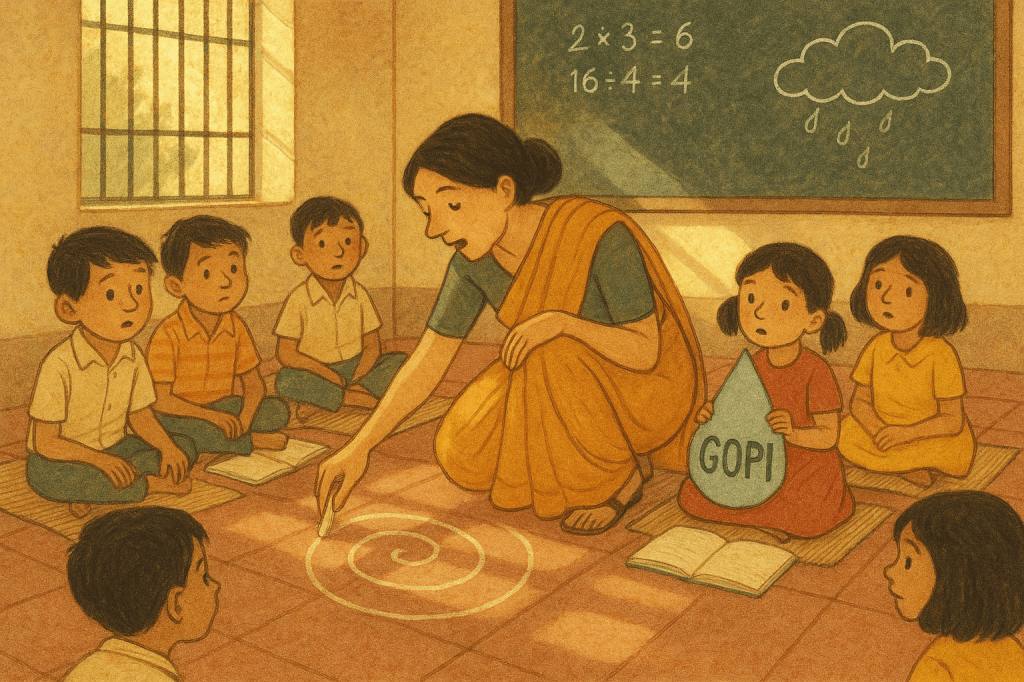
I once met a teacher in Udupi who explained the water cycle not through diagrams but through the journey of a little droplet named Gopi. Gopi evaporated, floated, condensed, and poured — sometimes as a storm, sometimes as a trickle on a school roof. The children named him. Drew him. Wrote to him. And never again forgot how clouds were made.
Clarity is not about being simplistic. It’s about being precise and alive.
And let’s not pretend this is only for classrooms. If you’re a principal addressing a staff meeting, a parent guiding a child, a speaker on stage — your clarity is your credibility. Your metaphors, your pauses, your stories — they are your legacy.
So here’s your invitation: Reconsider how you explain things.
Next time you plan a lesson or draft a talk, ask yourself — could I say this like I’m sitting across a fire, telling it to a child? Could I make it so vivid that they see it, smell it, feel it?
Because if you can explain it clearly — you’ve not just mastered the content.
You’ve mastered connection.
Coming Soon: The Storytelling Classroom—a professional development workshop by DreamScope Theatre, designed for educators, facilitators, and communicators seeking to elevate their teaching through the art of storytelling.
Because the future of education begins with how we speak, listen, and connect.
 DreamScope Theatre
Leave a comment